Pop Merrill
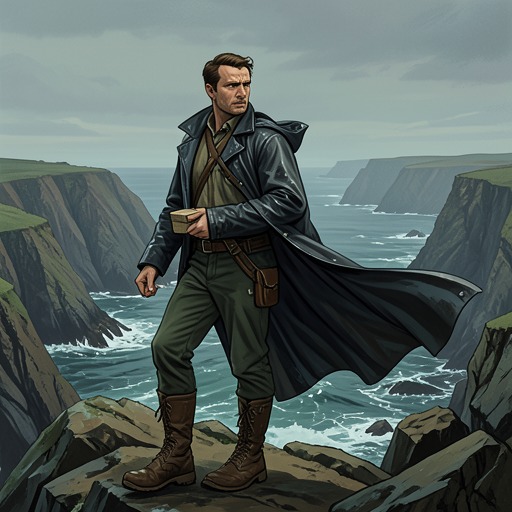
Needful ThingsPop Merrill, also known as Reginald Merrill, is Castle Rock’s miserly junk-shop proprietor, remembered through the burned-out Emporium Galorium, the rumors surrounding his death, and the inheritance of unresolved history taken up by his nephew Ace Merrill. His life is largely reconstructed through what the town says about him; in a novel crowded with bargains and objects whose value is more than practical, Pop’s shop and its destruction make him a local legend as well as a dead man.
Identity and Reputation
Pop ran the Emporium Galorium, a junk shop that stood across the street from the vacant lot left after it burned down. The town’s talk identifies him as an old miser, while Nan Roberts is described as perhaps the richest person around after Pop has died. His position in local memory is therefore bound to both money and the shop where he kept and traded goods.
That reputation is not the whole story. The fire that destroyed the shop also took Pop’s life, and residents who saw it—or say they did—insist over drinks at the Mellow Tiger that the blaze involved more than an ordinary accident. The uncertainty persists as a piece of Castle Rock lore: the account never resolves whether something uncanny happened or whether the story has grown through repeated telling.
Death and the Emporium Galorium
Pop’s death occurred before the principal action, but the circumstances remain an active mystery. His nephew Ace says that something strange happened to Pop before the fire, describing it as something like an episode of The Twilight Zone. Yet Ace was not present: he was serving a four-year sentence in Shawshank Prison for breaking and entering at night. His account is thus hearsay rather than eyewitness testimony, a distinction the town knows and does not let settle the matter.
The Emporium Galorium survives in the story as an absence—the vacant lot across from the shop’s former site—and as a story repeatedly revived over coffee, pie, and drinks. The narrator places the unresolved death among the secrets and grudges that enliven Castle Rock’s otherwise ordinary days. The town’s willingness to entertain the uncanny without deciding whether to believe it keeps Pop’s death suspended between local gossip and genuine supernatural possibility.
Ace Merrill and the Legacy of Pop
Ace’s connection to Pop continues after the older man’s death. When Pop dies, Ace is away in prison, completing his sentence; later, he becomes the family voice for the claim that the fire had a strange cause. The account also recalls Ace’s earlier reputation as one of the town’s worst school bullies, feared by children who crossed the street when they saw him approaching in his motorcycle jacket and engineer boots. That history makes his testimony compelling to some residents but does not make it reliable.
Pop’s death and the loss of the shop leave Ace with a past he can narrate but did not witness. The contrast between the nephew’s vivid certainty and the town’s unresolved speculation gives the story a productive ambiguity: belief in a supernatural explanation may preserve a real mystery, or may be another version of small-town talk.
Objects, Value, and the Town’s Memory
The novel’s wider attention to collectible and supposedly rare objects throws Pop’s identity as a junk-shop owner into relief. In the shop’s successor, Needful Things, merchandise has no price tags, and value emerges through the terms of exchange rather than a plainly displayed cost. The goods include a fragment said to come from Noah’s Ark, a Sandy Koufax card prized at ninety or a hundred dollars, and sunglasses presented as belonging to Elvis. These examples show how provenance, scarcity, and personal fascination can make an object worth far more than its ordinary use would suggest.
Pop’s Emporium is not described in enough detail to establish that it operated by the same methods. Its importance lies instead in the contrast between a dead shop that remains a local landmark in memory and a new store that turns desire into explicit bargains. Pop’s association with junk, money, and an unexplained fire places him at the edge of that theme: after his death, the town continues to assign value to the story of what happened to him, even though it cannot verify the account.
Narrative Significance
Pop is recalled rather than developed through present-tense action. His role is carried by fragments: the shop’s former location, the fire, the nephew’s absence, and the competing possibilities of supernatural event and embellished rumor. This indirect characterization makes him a measure of Castle Rock’s habits of memory. Residents preserve an unresolved story, repeat it in familiar social settings, and leave it open to belief without reaching a verdict.
That ambiguity also links Pop’s past to the novel’s broader unease. The town presents itself as a good place to live, where quarrels usually pass, yet its ordinary conversation contains old violence, private secrets, and tales that may not be merely tales. Pop’s unexplained death becomes one such breach in the reassuring picture: not a solved case, but a persistent question around which the town’s appetite for both mystery and gossip gathers.